
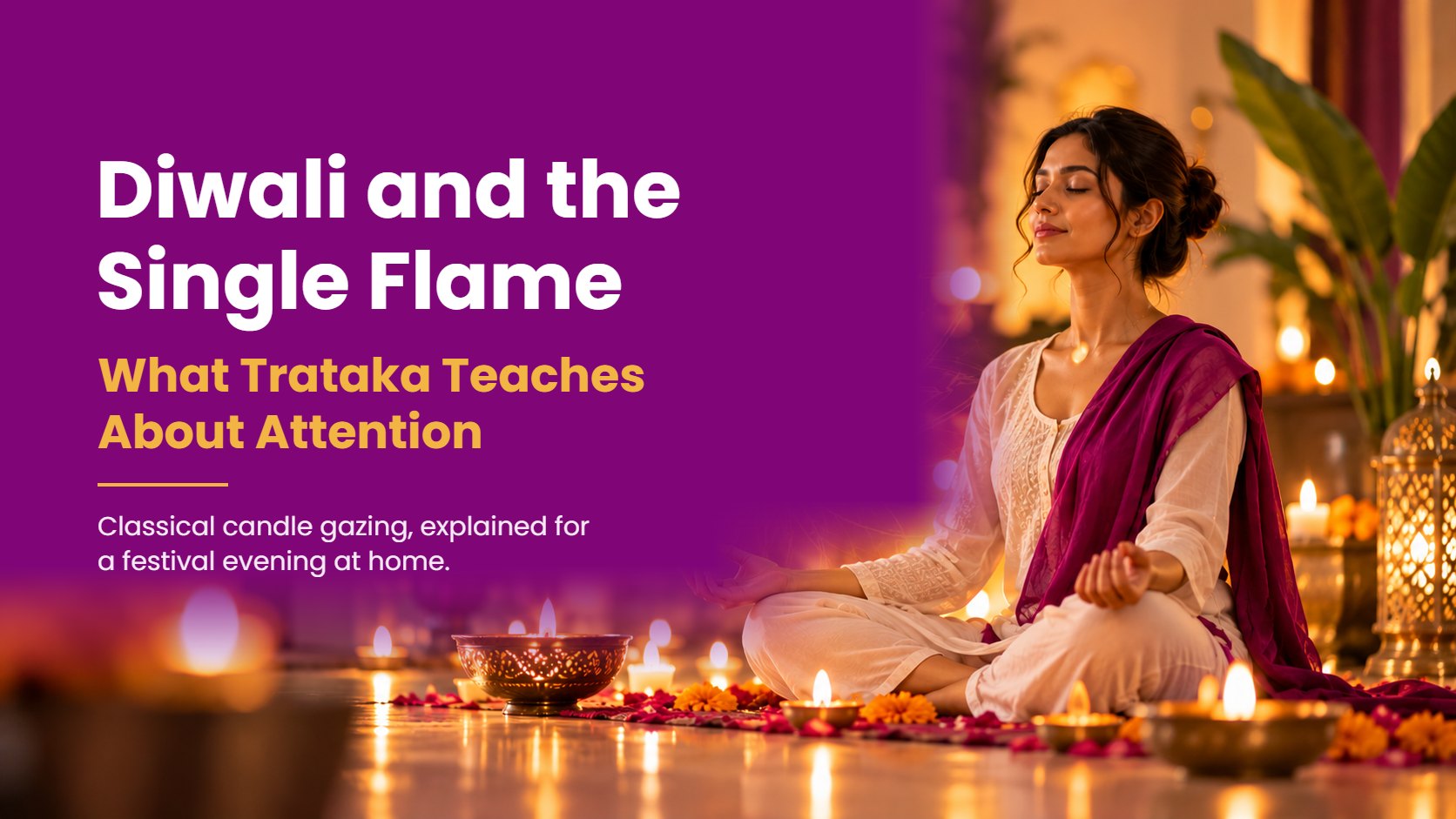
On Diwali evening, a great many lamps in Dubai will be photographed before anyone has looked at them properly. A diya goes onto a balcony railing in Karama, a phone comes up, the picture goes to the family group, and the eyes move on to the next screen. Nobody is doing anything wrong. Attention goes where it has been trained to go.
Trataka, the classical practice of gazing at a single flame, trains it the other way. Researchers at S-VYASA in Bengaluru tested this in a 2021 study published in Frontiers in Psychology: after one session of trataka, 41 young volunteers performed better on a standard test of working memory and spatial attention. An earlier randomized trial in the International Journal of Yoga, with 60 older adults, found that those who practiced trataka improved on tests of cognitive function compared with a wait-list group. Both studies were small, and neither turns the practice into a cure for anything. They do suggest that a few minutes with a flame changes something measurable in how the mind holds its focus.
Diwali falls on Sunday 8 November this year. It is not a public holiday in the UAE, so most families in Dubai light their lamps in the evening, after work and school. For one night, a whole household sits near a small flame on purpose. It is a good night to look at one properly.
A cleansing practice that ends in meditation
The Hatha Yoga Pradipika lists trataka among the six shatkarmas, the cleansing practices that prepare the body for deeper work. Its instruction is brief: fix the eyes on a small point, without wavering, until tears come. The text credits the practice with clearing eye trouble and dullness, and the Gheranda Samhita places it in the same family of purifications.
What makes trataka unusual is where it leads. Neti clears the nose. Dhauti clears the stomach. Trataka begins as an exercise for the eyes and becomes, almost without announcement, an exercise for the mind. Patanjali’s Yoga Sutras describe dharana, the sixth limb, as holding the mind to one place, and a candle flame is about the most literal version of that place anyone could choose.
Eyes that forget to blink
Long hours at screens change the eyes as well as the mind. A study of 452 people at Mohammed bin Rashid University of Medicine and Health Sciences and two Mediclinic hospitals in Dubai, reported by The National, found that 62.6 percent had dry eye disease, roughly three times a widely quoted global average. The figure rose to 66 percent among people with more than six hours of screen time a day, and the researchers named reduced blinking at screens, along with air conditioning, as likely contributors. That study dates from 2021. A year later, a report from the UAE’s Telecommunications and Digital Government Regulatory Authority put the average resident’s time online at 8.36 hours a day, nearly two hours above the global figure.
At first glance, trataka looks like more of the same. Another long stare. The difference lies in what the eyes are asked to do. A screen makes them chase: text scrolls, notifications jump, focus shifts dozens of times a minute, and the blink fades without anyone noticing. The flame asks for nothing. The gaze rests, the eyes water as the old texts say they will, and every round ends with the eyes closed and covered in the dark. Anyone with dry eye or another eye condition should still speak to their doctor before trying it.
What the flame shows about a wandering mind
Two minutes with a candle teach something slightly uncomfortable. The mind leaves. It goes to tomorrow’s meeting in Business Bay, to the dishes, to whether the photo was sent. Then it comes back and finds the flame exactly where it was.
That return is the practice. Classical commentary on the Yoga Sutras calls the scattered mind vikshipta and the one-pointed mind ekagra, and treats the movement from one to the other as a skill built through repetition, the way a stiff joint gains range over months rather than in a single class. Nobody is expected to hold the flame perfectly. What changes over weeks is how quickly a person notices the drift, and how little fuss there is in coming back.
I think this is part of why the tradition chose a flame over a dot on the wall. A flame moves. It flickers in the draft from an air conditioning vent, and each flicker is a small test of whether attention follows the movement or stays steady beneath it.
A trataka practice for Diwali evening
After the lamps are lit and the house settles, the practice needs about ten minutes:
- Sit on the floor or a firm chair with the spine upright, and place a candle or diya an arm’s length away or a little farther, with the flame at eye level.
- Dim the other lights, set the phone to silent and leave it in another room.
- Close the eyes for a few slow breaths, letting the jaw and shoulders soften.
- Open the eyes and rest the gaze on the tip of the flame, blinking as little as is comfortable, for one to two minutes at first.
- When the eyes water or tire, close them and watch the afterimage of the flame between the eyebrows until it fades.
- Rub the palms together, cup them gently over the closed eyes, and sit for a few breaths before opening them.
Two or three rounds are plenty for a first evening. Remove contact lenses beforehand. People with glaucoma, cataracts, a recent eye operation, epilepsy or light-triggered migraines should leave out the open-eye gazing and practice only the inner part, eyes closed, picturing the flame, or ask a teacher before starting.
Steadiness before stamina
Any practice that can be timed invites a contest with yesterday’s number. Classical teaching pulls the other way. The approach Lalitha Viswanath has built over more than 20 years of teaching in Dubai starts from the body, shaped in part by her training as a manual osteopath and Yoga Acharya. A gaze held with a clenched jaw, a lifted brow and shoulders creeping toward the ears is effort pretending to be concentration, and the body keeps that effort long after the candle goes out. Two soft minutes do more than ten rigid ones.
The same principle runs through classical hatha at our Oud Metha studio: alignment over intensity, awareness over achievement. Trataka makes the principle easy to see, because the face hides strain so badly.
After the lamps are put away
Diwali is one evening. The habit of looking at one thing at a time can outlast it by years. For anyone in Dubai who wants to take trataka further than a festival night, our meditation workshop teaches it alongside breath and the classical stages of meditation, a short drive from Karama, Bur Dubai and Healthcare City. Those who would like to see how the studio teaches first can book a trial session and ask about trataka on the day.
Happy Diwali from all of us at Pratimoksha.





0 Comments